Jigsawpics Puzzle Gallery
- 4.8
- Rating
- 500.00K
- Installs
- Free
- Price

 Analysis by App-foxy
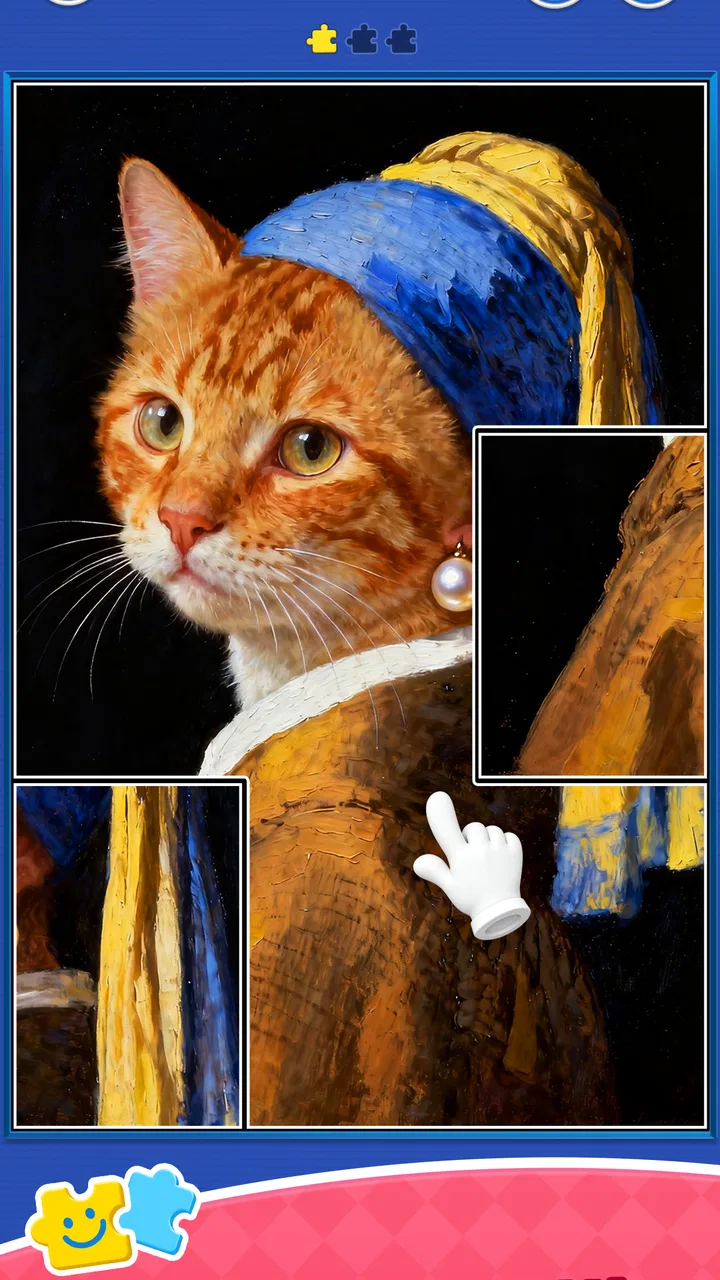
I spent time with Jigsawcard Palace Gallery, a free trivia game from UniRise Studio that builds its identity around one simple capability: sliding cards while collecting artifacts. That combination gives it a different feel from a standard question-and-answer quiz. Instead of treating every round as a quick test followed by a score, it makes progress feel more like arranging pieces in a small gallery.
The idea is easy to understand, but its value depends on whether you enjoy a slower, more visual kind of trivia. I found the game most appealing when I wanted something light that still gave me a reason to think. It is not the sort of title I would choose for a serious competitive quiz session, and it does not replace a full jigsaw puzzle or a deep collection game. Its strength is the space between those formats: short trivia play with a tactile card movement and a sense of discovery.
Why the sliding-card idea matters
The central capability is not just decoration. Sliding cards changes how I approached each interaction. In an ordinary trivia game, I usually read the question, tap an answer, and move on. Here, the card itself becomes part of the activity. The movement gives each decision a little more physical presence, so the session feels less like scrolling through a questionnaire and more like handling a set of objects.
You May Also Like

 Blood Strike: 2.5 Anniversary
Blood Strike’s Loadouts Turn Every Drop Into a Tactical Gamble
A close look at Blood Strike’s custom loadouts: how fast access to signature weapons reshapes its battle royale rhythm, rewards preparation, and narrows the gap between fights.

 Pandora - Music & Podcasts
Pandora’s Music Is Easy to Start, but Harder to Recover
Pandora’s strength is its low-effort path from a seed to a station. Its weak spot is how much confidence it asks you to place in connection, setup, and quiet recovery.

 8 Ball Pool
 Is Built on Rivalries, Rematches, and Routine
A close look at the rivalries, rematches, shared routines, and unanswered safety questions that turn a quick pool match into a persistent mobile community.

 Samsung Music
’s Quiet Strength Is Playing What You Already Own
Its reach comes less from spectacle than from dependable access to a personal library. That simplicity is both the app’s strongest retention engine and its ceiling.

 AccuWeather: Weather Radar
AccuWeather Review: A Quick, Clear Forecast for Everyday Decisions
For everyday plans, the best forecast is the one you can understand quickly. AccuWeather makes rain timing, radar, and local conditions easy to act on, with a few trade-offs.

 Hill Climb Racing
Why Hill Climb Racing Still Turns Crashes Into One More Run
A tiny car, a bumpy hill and one more upgrade: Hill Climb Racing keeps resurfacing because its simple chaos makes every near-miss feel personal.
More From Our News Desk
View All News


That distinction is useful for players who become tired of repetitive quiz screens. The gesture creates a small pause between one thought and the next. I had a moment to look at the card, consider what it represented, and then continue. It is a modest design choice, but it gives the game a recognizable rhythm.
The artifact-collecting side also changes the emotional payoff. A correct answer in a basic trivia app may only improve a score. In this game, progress is connected to the idea of building a gallery. Even when the individual challenge is brief, the collection gives me a reason to keep going. The strongest part of the design is the way a simple card action turns trivia progress into something visible.
That does not mean the game becomes a full museum-management experience. I would not install it expecting complex organization, detailed historical research, or a large strategy layer. The gallery concept works best as a motivating frame around the trivia and sliding interactions. It adds context without overwhelming the quick-play format.
What a session feels like
In practice, I found the game easy to pick up. The store summary points directly to its main loop, and the short description identifies it as a jigsaw-card experience. That gives a new player a fairly accurate expectation: this is a compact trivia game with cards to manipulate and artifacts to gather, not an action game or a conventional crossword-style puzzle.
The sliding action is particularly helpful during short breaks. I can imagine opening it while waiting for an appointment, taking a few turns during a commute, or playing for a few minutes before bed. The interaction does not demand the same uninterrupted attention as a long story game. At the same time, the collection angle can make a short session feel more purposeful than simply answering isolated questions.
One useful way to play is to treat each session as a small observation exercise rather than rushing for completion. I paid more attention to the card arrangement and the relationship between the visual presentation and the trivia prompt. That approach makes the game feel richer than tapping through as quickly as possible. It also helps if you are playing on a smaller phone screen, where hurried gestures can be less comfortable.
Another practical tip is to use the game as a low-pressure memory warm-up. I would not describe it as a study tool, because its purpose is entertainment, but the combination of reading, recalling, and physically moving cards gives the mind more to do than a single tap. For families, the Everyone age rating makes it a reasonable candidate for shared casual play, provided younger players are comfortable reading the questions and instructions.
The best everyday scenario
The clearest use case for me is a short evening session when I want something more engaging than passive scrolling but less demanding than a long game. I can play a few rounds, focus on the card movement, and stop without feeling that I have abandoned a complicated campaign. The artifact goal gives the session a gentle sense of completion.
It could also work well as a conversation starter. Two people can compare how they approached a card or discuss an answer without needing the game to become intensely competitive. That is where the gallery theme helps: it gives players something to talk about beyond whether one answer was right or wrong.
For a parent looking for a casual game suitable for a broad age range, the Everyone rating is reassuring as a basic starting point. I would still choose the experience based on the child’s reading ability and interest in trivia rather than the rating alone. The game seems better suited to curious players who enjoy collecting and visual interaction than to children looking for rapid action or animated spectacle.
It is also a sensible option for someone who likes puzzle apps but does not always have time to complete a traditional jigsaw. The card-based structure offers a smaller commitment. You get the satisfaction of arranging and progressing without needing a large image spread across a table or a long uninterrupted session.
Where it differs from ordinary trivia games
Compared with a standard trivia app, this game puts more emphasis on the journey between questions. A conventional quiz is usually strongest when it offers a large range of subjects, fast scoring, or direct competition. Jigsawcard Palace Gallery instead benefits from its physical-feeling card interaction and its artifact goal.
That difference is a strength when you want trivia to feel calmer and more tactile. It is a weakness if your main goal is speed. Players who enjoy racing through questions, comparing detailed scores, or testing themselves against a large competitive field may find the card movement slower than necessary. In that situation, a traditional quiz app would probably be the better choice.
It also differs from a normal jigsaw puzzle. A conventional jigsaw focuses on visual assembly, patience, and the satisfaction of completing an image. This game adds trivia to the experience, so knowledge and interpretation matter alongside arrangement. If you want a pure puzzle with no question element, this will not provide the same kind of concentration.
The comparison with collection games is equally important. Many collection-focused titles rely on elaborate progression systems, customization, or long-term planning. Here, collecting artifacts supports the main play rather than replacing it. I see that as a positive for casual players, but dedicated collectors may want more control over how their collection is organized or developed.
The tradeoffs behind the central mechanic
The sliding-card design gives the game personality, but any repeated gesture can become familiar. After the novelty wears off, the quality of the trivia and the satisfaction of collecting artifacts become more important. If the questions do not hold your interest, the card movement alone is unlikely to carry the experience for a long time.
There is also a balance between accessibility and depth. A simple interaction makes the game approachable, especially for people who do not normally play puzzle games. However, simplicity can limit the sense of mastery. I would not approach this as a game that rewards complex planning or advanced technique. Its challenge is more about recognizing information, making choices, and staying interested in the collection loop.
Screen size may affect comfort as well. Sliding cards is naturally more pleasant when there is enough room to see the card clearly and move it without covering important content with a finger. On a compact phone, I would slow down rather than swipe aggressively. That small adjustment makes the experience feel more deliberate and reduces the chance of moving something unintentionally.
The game is free, which lowers the barrier to trying it. That matters here because the appeal is quite specific: some players will immediately enjoy the mix of trivia, cards, and artifacts, while others will prefer a direct quiz. A free download lets you discover which group you belong to without treating the decision like a major purchase.
I would also keep expectations realistic about the rating. The game has an average rating of 4.9 from around 177 ratings, which is a very positive early signal, and it has passed 10K installs. Those figures suggest that the concept has connected with its initial audience, but they do not guarantee that every trivia fan will prefer its slower, more tactile format. I read the rating as encouragement to try it, not as proof that it replaces every alternative.
Who will get the most from it
The best audience is someone who likes trivia but wants a little more atmosphere and interaction than a list of multiple-choice questions. If you enjoy collecting visual rewards, moving cards, and playing in short bursts, the design makes sense. It is also a good fit for players who prefer a relaxed pace and do not need constant competition to stay interested.
It may appeal to families and casual groups because the basic concept is easy to explain. One person can introduce the card movement and artifact goal quickly, then let everyone discuss the trivia. The broad age rating supports that use, although the actual suitability still depends on the reading level and interests of the people playing.
New users should know that the game comes from UniRise Studio and is available at no cost. It was released on February 4, 2026, and the current version is 1.2.1. On Android, it supports devices beginning with version 7.0, so it is not limited to only the newest phones. Those details make it approachable for people using an older compatible device, especially if they want a small casual game rather than a demanding modern release.
I would skip it if I wanted a serious knowledge benchmark, a highly competitive leaderboard experience, or a traditional jigsaw with intricate assembly. I would also look elsewhere if I disliked collection mechanics altogether. The artifacts are not an optional flavor in the way I experienced the game; they are part of what gives the trivia its reason to continue.
Players who prefer action, reflex challenges, or constant visual change may find the pace too restrained. Likewise, someone seeking a dedicated educational reference should not treat it as a replacement for a subject-specific learning app. Its value is recreational: it encourages curiosity and attention without presenting itself as a formal course.
Small habits that improve the experience
I got more from the game when I avoided treating every round as a race. Taking a second to inspect the card before sliding it made the interaction feel more intentional. It also helped me separate the trivia decision from the physical gesture, which is useful when the screen feels busy or when I was playing on a smaller device.
For a shared session, I would let players explain why they chose an answer instead of immediately revealing who was right. That turns the artifact hunt into a light discussion and makes the game more social without requiring a formal multiplayer structure. It is a particularly good approach for mixed-age groups, where the conversation can be as enjoyable as the result.
For solo play, I would use the collection as a stopping point. Rather than continuing until the interaction becomes repetitive, I could finish after reaching a satisfying piece of progress and return later. This keeps the game in its strongest role: a compact break that has enough structure to feel worthwhile.
My overall impression is positive, with a clear qualification. Jigsawcard Palace Gallery is most successful as a tactile trivia break, not as an all-purpose quiz platform. The sliding cards give its questions a distinct physical rhythm, while the artifacts provide a gentle reason to continue. That is enough to make it memorable among lightweight trivia games, even though it does not offer the depth of a dedicated puzzle, collection, or competitive quiz alternative.
With a 4.9 average and a growing audience, it is easy to see why the concept has attracted attention. I would recommend giving it a try if you want free, Everyone-rated trivia that feels more visual and hands-on than a standard question list. If your priority is speed, deep strategy, or rigorous academic testing, another category of game will serve you better. For the right player, though, the card movement and artifact collection create a pleasantly focused way to turn a few spare minutes into a small gallery-building session.
FAQs for Jigsawpics Puzzle Gallery
01What is Jigsawcard Palace Gallery and what features does it offer?
Jigsawcard Palace Gallery is a captivating puzzle app that combines the challenge of jigsaw puzzles with the creativity of digital card collection. It features a wide array of themed puzzles, user-friendly interfaces, and a gallery to showcase completed works. Users can also customize puzzles, compete in challenges, and share achievements with friends.
02Is Jigsawcard Palace Gallery free to download and play?
Jigsawcard Palace Gallery is free to download on both Android and iOS platforms. While the basic version is free, it offers in-app purchases for premium features, additional puzzles, and customization options. This allows users to enhance their experience, but all essential functions are accessible in the free version.
03Can I play Jigsawcard Palace Gallery offline?
Yes, Jigsawcard Palace Gallery supports offline play. Once the app and puzzles are downloaded, users can enjoy assembling puzzles without an internet connection. However, some features such as sharing achievements and accessing new content may require being online.
04What age group is Jigsawcard Palace Gallery suitable for?
Jigsawcard Palace Gallery is designed for a wide range of ages, offering puzzles with varying levels of difficulty. It is suitable for children and adults alike, providing educational benefits such as improved problem-solving skills and enhanced concentration. Parental guidance is recommended for younger users to manage in-app purchases.
05How does Jigsawcard Palace Gallery ensure user privacy and data security?
Jigsawcard Palace Gallery prioritizes user privacy by adhering to strict data protection protocols. It collects minimal personal information, primarily for account creation and functionality enhancement. The app complies with relevant privacy laws and offers transparent terms of service, ensuring users' data is securely stored and never shared without consent.
Pros
- Intuitive interface for easy navigation.
- Extensive collection of jigsaw puzzles.
- Regularly updated with new puzzles.
- Offline mode available for on-the-go play.
- Customizable difficulty levels.
Cons
- In-app ads can be intrusive.
- Limited free puzzles without purchase.
- Occasional lag on older devices.
- High battery usage during play.
- Some puzzles require internet connection.

Jigsawpics Puzzle Gallery
Gallery